
English 
T: +86-17717097520
E: sales1@melko2015.com
E: sales1@melko2015.com
No.222 Xiangche Rd. Chedun Town Songjiang Dist. Shanghai China 201611


Views: 0 Author: Site Editor Publish Time: 2026-07-18 Origin: Site


Water and chemical filtration demand precision at every microscopic level. Inadequate filtration components compromise both product purity and system longevity severely. One critical, yet frequently overlooked factor is how filter surface geometry influences overall flow and particle retention. When standard options clog prematurely, bacteria and contaminants bypass your primary defenses. You need solutions tailored for high efficiency and strict microbial control. This article examines the vital role exterior structure plays in maximizing the effectiveness of a melt-blown antibacterial filter cartridge. We explore the mechanical advantages of various topographic patterns available today. You will discover how specific textures manipulate fluid dynamics and prevent premature system fouling. We analyze the science behind microbial resistance and surface area maximization. Finally, we provide actionable guidance on choosing the right geometric configuration for your industrial or commercial needs.
Polypropylene resins melt and extrude through highly specialized, fine nozzles. High-velocity air streams attenuate these polymer threads into microscopic fibers. They form a robust, complex fibrous web. This intertwined web acts as a highly efficient depth filter. It traps particles throughout its entire physical cross-section. Standard cartridges handle general sediment capture exceptionally well. However, microbial growth presents a unique operational challenge. Bacteria multiply rapidly in stagnant filtration zones. They form resilient biofilms. These biofilms blind the filter pores entirely. A standard unit degrades rapidly under these biological conditions.
Manufacturers incorporate specialized chemical agents to solve this dilemma. They embed antimicrobial additives directly into the hot polymer melt. This advanced process creates a permanent, non-leaching defense mechanism. The resulting matrix resists bacterial colonization inherently. It maintains designed flow rates far longer than standard alternatives. Industry standards often dictate strict microbial limits for processed fluids. Using these treated filters ensures consistent regulatory compliance. They protect sensitive downstream equipment from contamination. They also safeguard the final product quality. We see widespread adoption in food processing facilities. Pharmaceutical pre-filtration also relies heavily on their sterile performance.
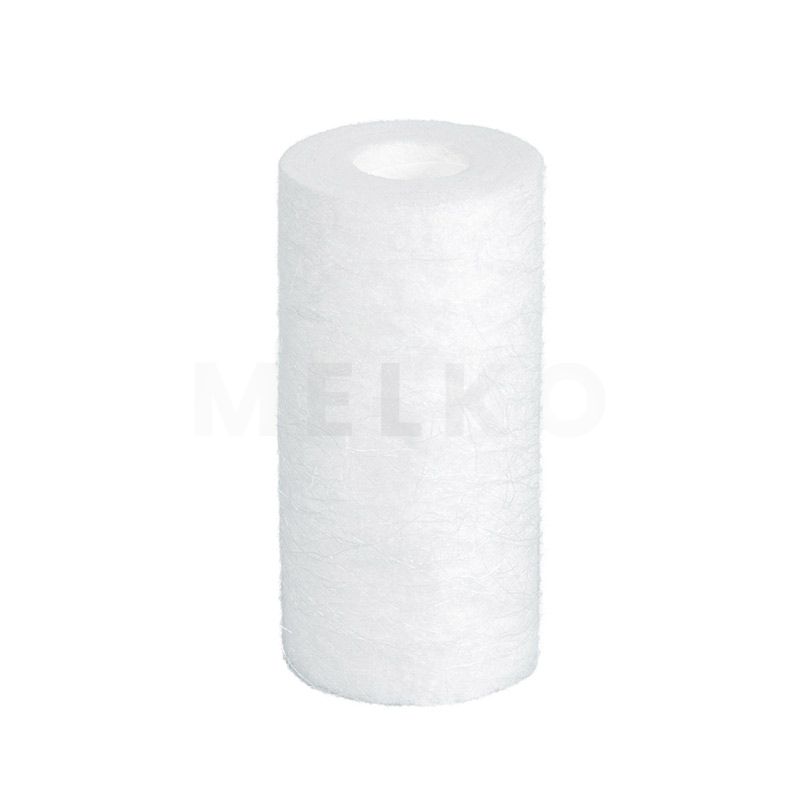
Fluid behaves very predictably when it encounters a solid barrier. Surface geometry dictates this hydraulic behavior entirely. A smooth cylinder deflects incoming flow in a highly uniform manner. This characteristic seems mechanically efficient initially. However, it quickly leads to catastrophic surface blinding. Large suspended particles accumulate rapidly on the outermost microfiber layer. They compress and form an impermeable exterior cake. This dense cake chokes off the underlying depth structure completely. The inner filtration layers remain completely clean. You waste the vast majority of the unit's dirt-holding capacity.
Altering the exterior topography changes fluid dynamics fundamentally. A heavily textured exterior disrupts standard laminar flow. It creates thousands of microscopic turbulent eddies. These small turbulent zones prevent rapid, uniform cake formation. Particles distribute much more evenly across the geometry. They penetrate deeper into the porous fibrous matrix. A specialized surface melt-blown cartridge leverages this hydraulic principle perfectly. By modifying the outer boundary layer, engineers increase the effective fluid contact area. The liquid spreads across a significantly larger footprint. This expansion reduces the localized fluid velocity safely. Lower velocity allows finer particles to settle into the pore structure gently. It prevents premature mechanical clogging. You maximize the true depth-filtration capabilities inherent in the design.
Antibacterial agents require direct physical contact to function properly. Microbes must touch the active treated fibers. If a filter face clogs quickly, the functional surface area disappears. A thick layer of accumulated dirt blocks the critical antibacterial sites. Bacteria can then proliferate safely on top of the dirt cake. They remain completely untouched by the active agents hidden beneath.
Optimized exterior designs solve this biological problem directly. By expanding the functional contact area drastically, you increase active exposure. Channels and textures expose much deeper fiber layers continuously. They maximize the total number of active antibacterial sites available. Contaminated fluids constantly wash over these aggressively exposed areas. This constant physical contact drastically reduces microbial survival rates. You maintain a sterile, safe environment much longer.
Real-world industrial scenarios highlight this critical importance perfectly. Consider a standard commercial cooling water loop. These closed systems harbor severe biological fouling risks. Algae and dangerous bacteria thrive in the warm, nutrient-rich water. A standard smooth filter fouls within a few short days. The resulting biofilm effectively seals the cartridge shut. The same system utilizing an optimized topography performs differently. The structural channels trap large debris while keeping active fibers totally exposed. The embedded antibacterial agents neutralize microbes rapidly upon contact. The system runs cleanly and efficiently for several weeks instead of days.
We categorize modern exterior designs into three primary types. Each unique style serves a highly specific operational purpose. You must match the exact design to your unique fluid characteristics.
Smooth finishes represent the basic industry standard. They offer highly consistent, predictable fluid flow characteristics. They work extremely well for fluids containing minimal suspended solids. You should deploy them primarily for final polishing applications. They excel when aggressive pre-filtration has already removed larger debris. However, they struggle heavily in high-load processing environments. They suffer from rapid, severe surface blinding. You will experience frequent pressure spikes if particulate levels rise unexpectedly.
This distinct finish resembles the dimpled skin of an orange. Manufacturers create this texture by manipulating ambient cooling rates during extrusion. The tiny dimples increase the total surface area moderately. They provide a very slight disruption to incoming fluid flow. This subtle texture delays standard surface blinding noticeably. It offers a highly reliable middle ground for operators. You achieve better overall life than a standard smooth filter. They handle moderate, fluctuating particulate loads quite effectively.
Deep grooving represents the most advanced exterior modification available. Manufacturers carve or mold specific, calculated channels into the exterior. These vertical or horizontal channels dramatically increase the total working surface area. A grooved melt-blown filter handles extreme dirt loads easily. The deep grooves act as integrated pre-filtration zones. They capture large gels and heavy agglomerated particles immediately. The inner valleys between grooves remain completely open. Fluid continues to flow smoothly through these protected valleys. This clever dual-action design extends service life exponentially. We highly recommend them for challenging, highly contaminated industrial fluids.
Deploying advanced geometric structures provides massive operational advantages. You will notice immediate, measurable improvements in overall system stability.
Surface Configuration Performance Matrix
| Surface Type | Surface Area Expansion | Dirt Holding Capacity | Optimal Application Scenario |
|---|---|---|---|
| Smooth Finish | Baseline (1x) | Low to Moderate | Final polishing, low TSS fluids, RO protection |
| Orange Peel | Moderate (1.3x) | Moderate | General water treatment, moderate TSS |
| Light Grooved | High (1.8x) | High | Viscous fluids, high biological loads |
| Deep Grooved | Maximum (2.5x+) | Exceptional | Heavy slurries, extreme TSS, severe bio-fouling |
Choosing your geometry correctly prevents massive operational headaches. We strongly recommend evaluating several critical fluid parameters before installation.
Many plant operators face frustrating premature failures due to poor initial selection. Avoid these frequent, highly disruptive industry pitfalls.
Certain heavy industries rely entirely on advanced geometric filtration structures. Their strict process requirements demand maximum efficiency.
In the food and beverage sector, operators battle constant microbial threats. Sugary syrups and rich juices create perfect bacterial breeding grounds. Standard smooth filters fail unacceptably fast here. Facilities deploy deeply grooved antimicrobial units to maintain strict sanitation. The channels handle the sticky organic pulp easily. The active fibers neutralize dangerous pathogens simultaneously. This ensures regulatory compliance and pristine flavor profiles.
High-purity industrial water generation faces similar intense challenges. Reverse osmosis (RO) membranes require absolute protection from incoming biological fouling. If bacteria breach the pre-filtration stage, they destroy the expensive RO membranes. Deeply textured antimicrobial cartridges serve as the ultimate protective barrier. They trap incoming algae and bacteria before they reach critical downstream components. Their massive surface area handles high continuous flow rates effortlessly.
Surface design dictates filtration success just as much as micron rating. A standard smooth finish simply cannot handle heavy biological or particulate loads efficiently. Upgrading to advanced textured geometries fundamentally changes your fluid dynamics for the better. You maximize your internal dirt-holding capacity and drastically extend operational lifespans. Furthermore, maximizing surface area guarantees your antimicrobial agents perform at their absolute peak.
Evaluate your process lines today to identify rapidly failing smooth cartridges. Measure your fluid viscosity and current biological risks carefully. Transition challenging filtration points to heavily grooved antimicrobial solutions. You will immediately stabilize differential pressures and eliminate rapid surface blinding. Protect your downstream equipment and streamline your entire maintenance schedule by choosing the optimal exterior structure.
A: Grooved surfaces drastically increase the available exterior contact area. They break up uniform fluid flow and prevent a solid cake from forming rapidly. Large debris settles into the wide channels, leaving the peaks and inner valleys completely open for continuous, efficient fluid passage.
A: We strongly advise against it. Thick fluids like oils or heavy syrups blind smooth exteriors almost immediately. You will experience severe pressure spikes. Always deploy deeply grooved or heavily textured structures to handle the extreme physical stress of high-viscosity liquids safely.
A: Antibacterial agents embedded in the polymer require direct physical contact to destroy microbes. Expanding the surface area through texturing exposes far more of these active agents. It prevents a thick dirt layer from shielding the bacteria from the lethal treated fibers.
A: You must monitor differential pressure daily. Spikes indicate that the surface geometry has reached its holding capacity. Pushing a filter past the manufacturer's recommended pressure limit forces trapped dirt through the media, severely contaminating your downstream process equipment.
A: No. An orange peel finish offers only a moderate increase in total surface area. It delays blinding better than smooth units but falls short under extreme dirt loads. Deeply grooved designs handle significantly heavier particulate volumes and provide maximum longevity in harsh conditions.

