
English 
T: +86-17717097520
E: sales1@melko2015.com
E: sales1@melko2015.com
No.222 Xiangche Rd. Chedun Town Songjiang Dist. Shanghai China 201611


Views: 0 Author: Site Editor Publish Time: 2026-07-15 Origin: Site


Premature filter clogging ruins operational efficiency across multiple industries. System pressure drops often stem directly from severe biofouling. This frustrating issue frequently plagues stagnant or untreated water environments. Operators traditionally rely on standard polypropylene media to handle these environments. The standard unit serves as the reliable industry workhorse for inorganic sediment removal. It traps dirt effectively. However, demanding environments require a tougher, more specialized approach.
The melt-blown antibacterial filter cartridge provides a highly practical solution. It directly addresses microbial growth on the filter media. It achieves this protection without altering core sediment filtration mechanics. We will explore the vital technical differences between these two options. We will also provide a detailed financial comparison. This guide helps you determine if the antibacterial upgrade makes sense for your specific application. You will learn exactly when to switch and when to stay the course.
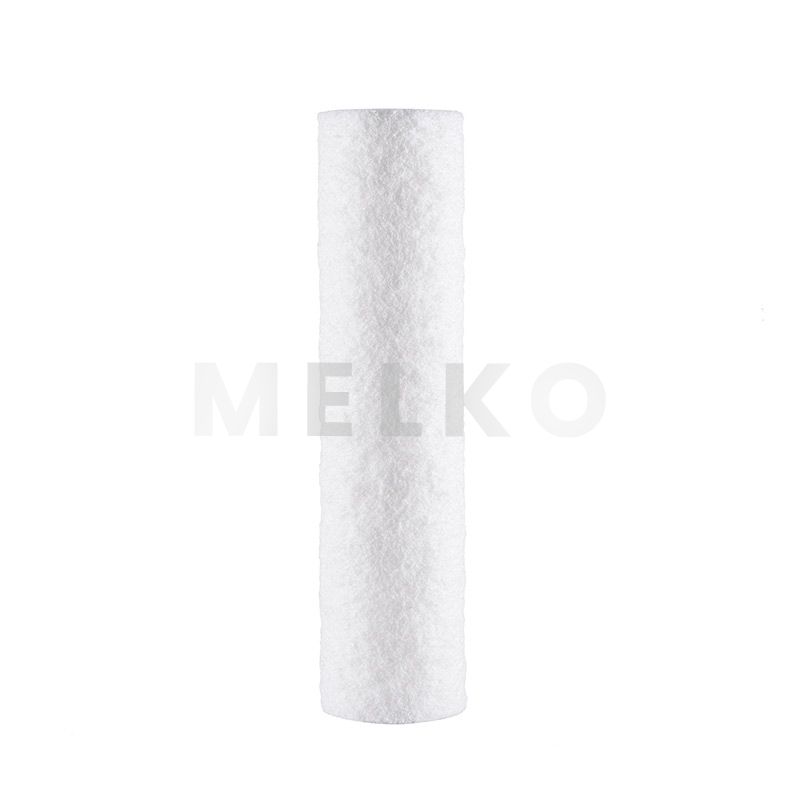
Understanding the manufacturing process reveals exactly how these two filters differ. We start by detailing the standard PP melt-blown filter. Manufacturers create these using thermally bonded pure polypropylene microfibers. They rely on a highly effective graded density structure. The outside layers remain looser. The inside layers grow progressively tighter. This specific design enables excellent depth filtration.
The standard media traps larger particles on the surface. It catches finer sediment near the rigid core. This extends the overall dirt-holding capacity. However, this traditional design carries a specific vulnerability. Pure polypropylene provides an ideal surface where organic matter accumulates. This organic matter creates a perfect breeding ground for bacteria in unchlorinated water. The filter becomes a host for biological colonies.
Antibacterial alternatives solve this structural vulnerability at the manufacturing level. Factories introduce an EPA-registered or FDA-compliant antimicrobial agent directly into the raw material. They blend this agent into the polymer melt prior to extrusion. Heat melts the resin and the additive together. Extrusion forces the mixture through tiny nozzles.
Cool air solidifies the mixture into continuous microfibers. The active agent embeds deeply within the structural matrix of the fibers. It is not a temporary surface coating. This permanent integration ensures the agent does not wash away. It will never leach into your clean filtrate. Despite this chemical addition, the media maintains exact physical filtration capabilities. You get the same graded-density structure as standard models. The core mechanical filtration process remains entirely unchanged.
Engineers evaluate filter performance using three main metrics. You must look at initial flow rate, pressure drop curves, and total usable lifespan. How do these two options compare right out of the box? Both filters perform identically during initial setup. A 5-micron standard unit and a 5-micron antibacterial unit deliver the exact same initial flow rate. They also share identical particle retention efficiency. You will not notice a measurable difference on day one.
Differential pressure (ΔP) over time tells a drastically different story. In environments carrying heavy organic loads, biofilm forms rapidly. We can track this failure mode through a predictable cycle:
This slime blinds the filter pores on standard models. It causes a severe and premature spike in differential pressure. You lose flow capacity quickly. This happens even if the filter has not reached its maximum inorganic dirt-holding capacity. You end up discarding a filter capable of holding much more physical sediment.
Conversely, the antibacterial model strongly resists biofilm formation. The pressure drop curve remains linear and highly predictable. Sediment loading strictly drives the pressure drop. Biological blinding no longer dictates your replacement schedule. Preventing biofouling extends the operational lifespan of the filter. You maximize the utilization of its depth-filtration capacity. You change filters based on actual sediment saturation, not sudden slime buildup.
| Performance Metric | Standard Polypropylene | Antibacterial Modification |
|---|---|---|
| Initial Flow Rate | Excellent | Excellent |
| Biofilm Resistance | None | High |
| Pressure Drop Curve (Organic Water) | Spikes prematurely | Remains linear |
| Primary Failure Mode | Biological blinding | Sediment saturation |
| Usable Lifespan in Well Water | Short (Days/Weeks) | Extended (Months) |
You do not always need an expensive upgrade. Standard units work perfectly in specific controlled environments. Municipal water systems represent a prime example. They contain consistent active residual chlorine. This free chlorine naturally oxidizes bacteria. It prevents biological growth on the media. The filter stays completely clean of slime.
High-turnover industrial processes also favor standard filters. Manufacturing facilities often swap these filters daily or weekly due to massive sediment loads. Biological fouling takes time to develop. Frequent filter changes make biofouling a non-issue. Pre-filtration for reverse osmosis (RO) systems offers another excellent use case. Plant operators usually manage biological loads strictly upstream using chemical dosing. This protects downstream standard filters from slime accumulation.
Certain challenging scenarios absolutely demand a technology upgrade. Well water systems top this critical list. Residential or agricultural well water users frequently deal with stubborn iron bacteria. Untreated groundwater presents massive biological challenges. Standard filters often clog within mere days in these harsh conditions. Farmers and homeowners need robust protection.
Food and beverage facilities also require this advanced technology. These processing environments contain abundant organic matter. Plant managers must minimize chemical sanitizers to protect product flavor profiles. The antibacterial PP filter provides strong mechanical protection without adding harsh chemicals to the fluid stream.
Intermittent flow systems pose unique biological risks. Recreational vehicles (RVs), marine applications, and emergency backup systems often sit idle. Water sits stagnant inside the closed filter housing. This stagnant environment creates a high risk for severe bacterial blooms. The antibacterial media prevents these foul blooms during long periods of downtime.
We must carefully examine the financial implications of this upgrade. Upfront procurement costs heavily favor standard filters. An antibacterial model carries premium pricing compared to a standard commodity unit. You will undeniably pay more at the initial checkout counter. Buyers often hesitate at this price difference.
However, standard models hide massive long-term costs when deployed in the wrong applications. You must accurately calculate the true cost of premature replacements. These hidden expenses add up rapidly:
The return on investment (ROI) formula remains remarkably straightforward. Ask yourself why your standard filter fails. Does it fail primarily due to slime? Does bio-film ruin the unit before inorganic sediment actually saturates it? If you answer yes, upgrading reduces your overall maintenance expenses immediately. The premium cartridge usually pays for itself within one or two replacement cycles. You buy fewer filters annually. You spend less time changing them. Your pumps work less hard.
You must manage your operational expectations properly before upgrading. This technology functions as a bacteriostatic filter. It actively protects itself from biological degradation. It is not a bactericidal point-of-use water purifier. It will never render contaminated water safe to drink. Post-filtration sterilization remains strictly required for unsafe water sources. You still need secondary treatments like UV sterilization or active chlorination.
Regulatory compliance matters immensely for safe deployment. Ensure your selected cartridge officially meets NSF/ANSI 42 or 61 standards. These important standards govern material safety and structural integrity. If you operate within the food and beverage sector, verify the specific antimicrobial agent. It must hold explicit FDA approval for direct food-contact applications. Never compromise on proper safety certifications.
Chemical compatibility requires strict verification before installation. Standard pure polypropylene naturally resists many harsh chemicals. You must confirm the added antimicrobial agent does too. Ensure it does not negatively interact with specific industrial solvents used in your facility. Check its operational tolerance for extreme pH levels. A quick compatibility check prevents highly costly system failures down the line.
Let us summarize this practical decision framework. Choose standard polypropylene for actively chlorinated systems. Use it confidently for high-turnover industrial operations. Rely on it for purely inorganic sediment applications where biofouling never occurs. Conversely, choose the antibacterial variant for untreated well water. Deploy it in stagnant, intermittent systems. Trust it in any operational environment prone to heavy bio-fouling.
Take direct action by auditing your current filter failure modes. Examine your discarded filters closely. If they feel noticeably slimy upon removal, take note. If system pressure drops occur much faster than sediment loads suggest, investigate immediately. These signs indicate a severe biological problem. Initiate a pilot test using antibacterial cartridges. Monitor the pressure drop and lifespan carefully. You will likely see immediate and highly profitable operational improvements.
A: Yes, if your goal involves achieving better dirt-holding capacity without risking fiber migration. Melt-blown options offer superior density gradients compared to wound strings. However, if your process fluid reaches extreme temperatures (over 180°F), polypropylene will eventually soften and fail. A cotton or glass-fiber string-wound filter remains absolutely necessary for those specific high-temperature thermal conditions.
A: No. It operates as a bacteriostatic device, meaning it simply inhibits the growth of bacteria directly on the filter media itself. This prevents biofilm buildup, slime, and foul odors inside the housing. It does not guarantee the downstream water becomes microbiologically safe to drink without secondary treatment like UV sterilization.
A: The antimicrobial agent is permanently embedded into the polymer melt-blown fibers during the initial manufacturing extrusion process. Because it functions as a structural component and not just a temporary surface coating, the biological protection lasts for the entire functional lifespan of the filter cartridge. It does not wash away.
A: High-quality antibacterial PP filters use non-leaching, structurally bound agents. Manufacturers frequently use highly safe, silver-based additives. These specific materials are strictly regulated and certified by testing bodies like NSF. This rigorous certification ensures no harmful chemicals ever enter the water stream, making them safe for sensitive applications.

