
English 
T: +86-17717097520
E: sales1@melko2015.com
E: sales1@melko2015.com
No.222 Xiangche Rd. Chedun Town Songjiang Dist. Shanghai China 201611


Views: 0 Author: Site Editor Publish Time: 2026-07-11 Origin: Site


Designing miniature fluid filtration requires a delicate engineering balance. You cannot simply shrink components and expect identical performance. Scaling down water treatment systems introduces unique operational challenges. Engineers must maintain pressure tolerance, secure high flow rates, and ensure ease of maintenance inside tightly constrained spaces. Casing materials play a critical role here, prompting a major industry shift toward high-strength polymers instead of traditional metals or opaque plastics.
Evaluating the technical viability, operational limits, and procurement criteria for integrating a PET filter casing purifier into residential or light-commercial setups remains our primary objective. We will explore specific design advantages, material comparisons, and risk mitigation strategies. You will learn how to optimize your next modular system effectively while strictly maintaining regulatory compliance.
Define a highly reliable compact water purifier carefully. It must balance massive volumetric throughput inside an extremely constrained spatial footprint. Common modern setups include under-sink residential units, mobile RV installations, or modular commercial beverage arrays. Space remains at an absolute premium in these environments. You cannot afford bulky exterior framing. Every component must justify its physical dimensions.
Maintenance constraints heavily dictate subsequent design choices. Limited physical access makes routine servicing highly difficult. Components must remain easy to evaluate visually. Users need the ability to replace cartridges quickly. They should never require highly specialized tools just to perform routine maintenance. Complicated housings lead directly to neglected filter changes.
Pressure dynamics introduce another severe engineering hurdle. Smaller systems often experience highly frequent pressure cycling. Rapid pump activations or sudden valve closures create violent water hammer effects. Casings must withstand these sudden hydraulic shocks effortlessly. Repeated expansion and contraction inevitably test material boundaries. Structural fatigue or microscopic micro-fissures will ultimately cause disastrous leaks. To meet these harsh physical demands, engineers scrutinize structural polymers deeply.
Consider these specific design pressures:
Engineers must continuously choose between several polymer formulations and legacy metal options.
Polypropylene serves as a standard industry workhorse material. However, PET offers one massive primary advantage: brilliant optical clarity. Operators and end-users can visually confirm filter exhaustion instantly. They do not need to depressurize the system. They simply look directly at the internal cartridge. This saves tremendous maintenance time in commercial settings. Additionally, we must rigorously compare tensile strength. PET generally offers much higher rigidity. This specific characteristic allows structural engineers to specify slightly thinner walls during the injection molding process. Thinner walls result in a smaller external footprint without sacrificing internal volume.
Polycarbonate previously dominated the clear housing market for decades. Today, changing regulatory compliance alters everything. PET completely eliminates the well-documented BPA-leaching concerns commonly associated with older polycarbonate housings. It meets stricter modern food and beverage safety standards natively. You can specify PET confidently for high-purity drinking water applications without risking consumer health or facing compliance audits.
Stainless steel provides genuinely unmatched ultimate yield strength. Yet, it carries a remarkably heavy financial cost. PET reduces upfront unit manufacturing costs significantly. It also lowers the overall assembled weight drastically compared to fabricated steel. Heavy steel remains absolutely necessary for extreme high-pressure industrial environments or scalding hot water applications. However, for standard residential or light commercial usage, premium polymer casings make far more economic and functional sense.
Material Properties and Application Comparison Chart
| Material Type | Visual Clarity | BPA-Free Compliance | Relative Weight | Best Application Environment |
|---|---|---|---|---|
| PET (Polyethylene Terephthalate) | High (Transparent) | Yes | Lightweight | Cold/Ambient residential or light commercial |
| PP (Polypropylene) | Low (Opaque) | Yes | Lightweight | General municipal water, outdoor variants |
| PC (Polycarbonate) | High (Transparent) | No (Often contains BPA) | Medium | Legacy industrial systems (phasing out) |
| Stainless Steel | None (Opaque) | Yes | Heavy | High-pressure, hot water, harsh chemicals |
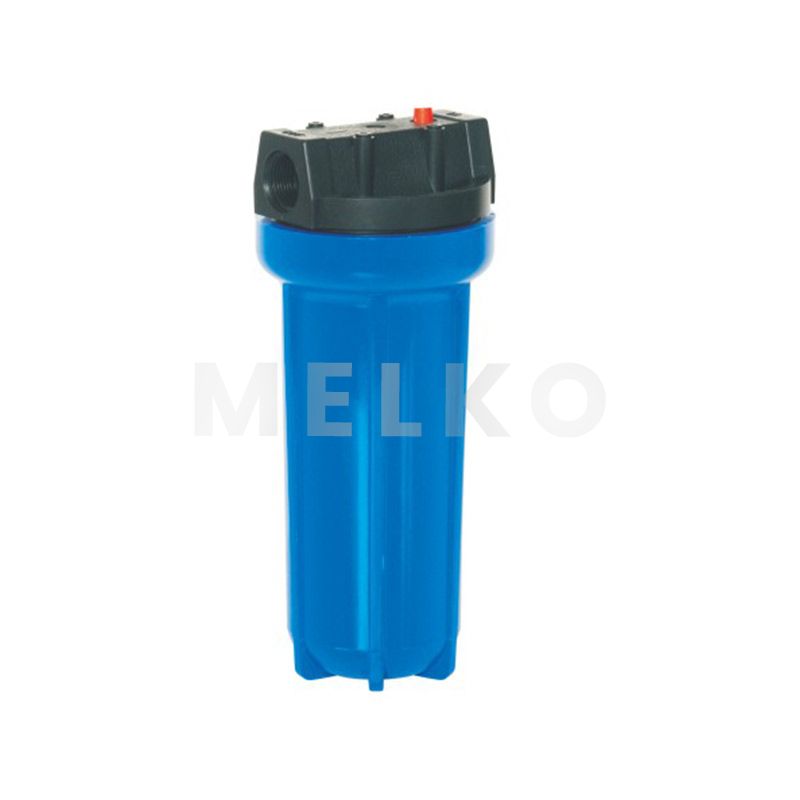
Modular engineering relies heavily on predictability and tight tolerances. Supreme dimensional stability makes a PET filter housing completely ideal for complex multi-stage layouts.
Footprint optimization remains crucial for system builders. Engineers can design much tighter multi-stage mounting brackets. The highly rigid nature of the polymer prevents physical warping under operational pressure. This precise stability allows separate housings to sit much closer together safely. You save valuable cabinet space instantly.
Port configuration and integration also streamline the final assembly process. Manufacturers mold standardized inlet and outlet threading directly into the durable PET head or cap. Common global standards include precise NPT or BSP thread patterns. Flawless precision molding ensures leak-free integration every single time. It connects seamlessly to standard metal or plastic plumbing manifolds without requiring excessive thread sealants.
Consider these powerful modular benefits:
You save money on outbound freight operations. You also prevent structural strain on residential wall installations, leading to fewer customer complaints.
Every single material possesses strict operational boundaries. Recognizing them ensures long-term system reliability.
Transparent PET is strictly formulated for cold or ambient water applications only. It is typically rated safely up to 100°F (37.8°C). Running hot water through these specific units poses a severe operational risk. The polymer material will soften rapidly. It will experience catastrophic thermal deformation, leading to immediate seal failure and flooding. Always verify inlet line temperatures before permanent installation.
Municipal water sources commonly contain chlorine or chloramine disinfectants. PET resists these standard municipal water chemicals perfectly over long lifespans. However, it shows critical vulnerabilities to certain harsh industrial solvents. Aggressive cleaning agents or localized chemical spills can cause rapid crazing or severe cracking. Furthermore, do not use petroleum-based lubricants on the internal O-rings. They will chemically degrade the surrounding polymer head quickly.
Direct sunlight degrades untreated PET at a rapid pace. The polymer molecular chain breaks down, turning the housing extremely brittle. We strongly recommend installation completely inside enclosed dark cabinets. If the unit must sit exposed to ambient environmental light, utilize specialized UV-stabilized variants. Blocking ultraviolet radiation prevents unexpected mechanical ruptures down the road.
Standard safe operating pressures generally range between 90 and 125 PSI. Municipal systems often experience sudden, violent pressure spikes during the night. Incorporating dedicated pressure relief valves (PRV) into your system design is an absolute engineering necessity. A PRV bleeds off excess hydraulic force instantly. It prevents catastrophic housing failure during a massive water hammer event.
Procurement requires strict, uncompromising validation. Buyers must verify several technical benchmarks before committing to large supply contracts.
Always demand proper, up-to-date documentation. Look specifically for NSF/ANSI 42, which comprehensively covers material safety parameters. Also, strictly verify NSF/ANSI 61 compliance for safe drinking water system components. These rigorous certifications guarantee the core material will never leach harmful toxic contaminants into the clean water stream.
Evaluate the internal sealing mechanism carefully during your review. Choose diligently between single or double O-ring designs. Double O-rings consistently provide superior long-term leak prevention against pressure surges. Material selection matters immensely here as well. Ensure the supplied seals use premium, high-quality Buna-N or highly resistant EPDM rubber.
Assess baseline manufacturing tolerances during your physical sample review. High-quality transparent casings must feature a perfectly uniform wall thickness from top to bottom. Thin spots act as dangerous weak points during sudden pressure spikes. Examine the internal threads closely for incredibly smooth, burr-free finishes to prevent cross-threading during cartridge replacements.
Reliable global manufacturers readily provide verifiable laboratory testing data. Request comprehensive burst test and cyclic test documentation upfront. Cycle testing closely simulates years of daily pressure fluctuations in mere weeks. Burst testing mathematically confirms the ultimate static failure point. Never purchase unverified, untested housings for any active pressurized lines.
Engineers require highly dependable, thoroughly tested materials. A PET filter casing purifier serves as a technically sound, remarkably efficient choice for cold-water compact systems. It delivers excellent visual condition monitoring capabilities. It also maximizes extremely limited available cabinet space perfectly.
Always align your exact system operating parameters precisely. Compare local peak water pressure and maximum temperature ratings directly against official manufacturer specifications before moving to mass production integration. This simple validation step prevents incredibly expensive field failures and protects your brand reputation.
Moving forward, streamline your vendor validation process immediately. Request official material data sheets from your short-listed suppliers. Order physical sample units immediately for rigorous internal pressure testing. Dedicated physical evaluation guarantees absolute success for your next compact filtration build.
A: Most standard transparent polymer housings operate safely up to 125 PSI. However, pressure spikes occur frequently in municipal lines. We strongly recommend installing a pressure regulating valve before the filtration system to prevent sudden surges from compromising the casing.
A: No. These transparent polymers are strictly rated for cold or ambient water, typically maxing out around 100°F (37.8°C). Hot water will deform the casing. For hot water, specify glass-filled nylon or stainless steel alternatives instead.
A: Yes. Polyethylene Terephthalate is inherently BPA-free. It meets stringent food and beverage safety standards. This distinguishes it clearly from older polycarbonate models, making it entirely safe for residential drinking water applications.
A: Industry standards typically recommend casing replacement every 5 to 10 years. The exact timeline depends on environmental wear, UV exposure, and daily pressure cycling. Regular visual inspections help identify micro-fissures or crazing before a complete structural failure occurs.

