
English 
T: +86-17717097520
E: sales1@melko2015.com
E: sales1@melko2015.com
No.222 Xiangche Rd. Chedun Town Songjiang Dist. Shanghai China 201611


Views: 0 Author: Site Editor Publish Time: 2026-07-10 Origin: Site


Choosing the wrong filtration housing exposes systems to severe operational risks. Catastrophic leaks can easily flood facilities. Compliance failures often bring industrial operations to a costly halt. You also risk unnecessary capital expenditure if you over-engineer a simple filtration setup. Today, facility managers and system engineers typically choose between two dominant materials. Engineered plastics, particularly polyethylene terephthalate (PET), provide highly reliable everyday performance. Meanwhile, metal options like stainless steel dominate heavy-duty industrial applications.
We created this objective, engineering-focused evaluation guide to help you make the right choice. Our goal is to help you match your housing material to specific pressure, temperature, and fluid requirements. You will learn how to align system demands with the exact right material profile. We explore the specific boundaries and failure points of each option. By the end, you can confidently specify a housing designed to survive your unique operational environment.
Before designing a filtration system, we must understand the fundamental material science behind our options. Each material reacts differently to mechanical stress and chemical exposure.
Polyethylene terephthalate (PET) is a highly durable, engineered thermoplastic. Manufacturers utilize injection molding to create these housings. This process ensures precise threading and consistent wall thickness. You will frequently see a PET filter casing purifier integrated into point-of-use (POU) and point-of-entry (POE) systems. They form the backbone of residential and light commercial water treatment.
The primary operational advantage of PET lies in its transparency. Many manufacturers offer clear sumps. This transparency allows operators to perform visual flow and filter inspections instantly. You can easily spot heavy sediment buildup. You never have to shut down the system or open the housing just to check the filter status.
Best Practice: Always install transparent PET housings in areas shielded from direct sunlight to maintain material integrity.
Industrial applications demand a much tougher baseline. This is where metal alloys take over. Facilities primarily rely on two common grades: 304 and 316L stainless steel. Grade 304 handles general industrial water and mild chemicals effectively. Grade 316L includes added molybdenum. This critical addition significantly boosts resistance to chlorides and harsh industrial acids.
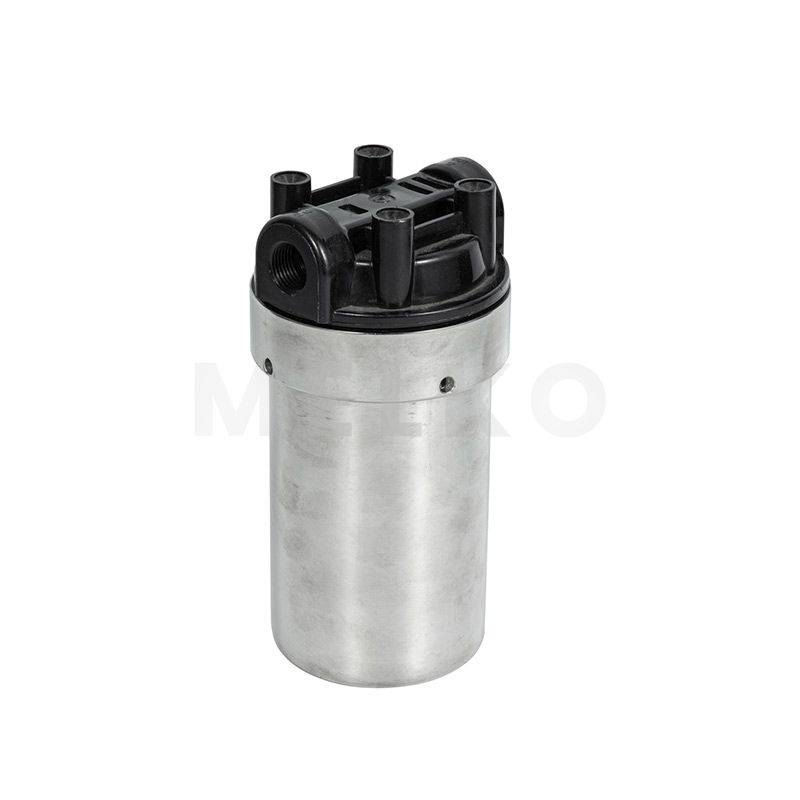
Manufacturers build a stainless steel filter housing using robust construction methods. You will typically find them welded, cast, or machined. Machined housings offer incredibly smooth, seamless interiors. Cast housings provide massive structural heft for extreme environments. Welded sheet metal units offer a balance of moderate weight and high strength.
Thermal and pressure boundaries dictate most initial material selections. Plastics have strict upper limits regarding heat. A standard plastic filter housing typically maxes out between 100°F and 120°F. If you expose PET to sustained heat above this threshold, the material softens. Its pressure ratings also drop significantly as temperature rises. Standard PET pressure thresholds usually cap at 100 to 125 PSI. Exceeding these limits risks catastrophic bursting.
Stainless steel demonstrates massive superiority in extreme environments. It effortlessly withstands extreme temperatures, often operating well above 200°F. It also handles intense high-pressure ratings, frequently supporting 150 to 300+ PSI. Furthermore, stainless steel resists thermal shock. Sudden temperature changes that would instantly crack plastic have no effect on heavy-duty metal housings.
You must match the housing material to the specific fluid chemistry. A plastic filter housing actually excels in several specific scenarios. It handles deionized (DI) water perfectly, whereas DI water can strip ions from standard metals. PET also handles seawater brilliantly because it suffers zero galvanic corrosion. It also resists specific mild acids where standard stainless steel might begin to pit.
Conversely, stainless steel excels in aggressive industrial environments. It perfectly handles harsh solvents that would melt plastic housings. It safely contains high-pH caustics. It also survives environments requiring regular steam sterilization. However, you must carefully monitor chloride levels. Grade 304 stainless remains highly vulnerable to high-chloride environments like brine. In these cases, engineers strongly recommend upgrading to 316L.
Common Mistake: Assuming stainless steel is universally chemically resistant. Always verify your fluid against a specific metallurgical compatibility chart.
Initial budgets and long-term durability look very different between these two materials. PET offers an exceptionally low upfront capital expenditure (CapEx). It fits easily into tight maintenance budgets. However, PET threads and O-ring grooves wear out much faster under frequent filter changeouts. Continuous opening and closing degrade the plastic threading over time.
Stainless steel requires a noticeably higher initial CapEx. Yet, it delivers a near-permanent lifecycle. The heavy-duty metal threads rarely wear down under normal maintenance. For facilities with decades-long operational horizons, stainless steel often proves cheaper overall by eliminating recurrent replacement cycles.
Hydraulic shock, commonly known as water hammer, destroys filtration systems. When valves close rapidly, fluid momentum creates a massive pressure spike. This shockwave slams into the filter housing. In PET housings, repeated water hammer causes microscopic stress fractures. Over time, these micro-fractures grow. They eventually lead to sudden, catastrophic bursts. Stainless steel simply absorbs these shocks without fracturing.
Environment plays a huge role in material survival. Installing PET in direct sunlight introduces a severe risk of UV degradation. Ultraviolet light breaks down the polymer chains within the plastic. This photo-oxidation causes structural weakening and extreme brittleness. A once-flexible plastic housing can shatter under normal system pressure if left exposed to the sun for years.
Engineers often overlook the installation reality of stainless steel. Metal is heavy. When full of water, a stainless steel filter housing exerts massive downward force. You cannot simply hang it from standard PVC piping. Heavy housings require proper wall mounting brackets or dedicated floor stands. Failing to provide adequate support strains the inline pipe connections, eventually causing joint leaks or pipe failure.
While metal is tough, it has unique vulnerabilities during maintenance. Thread galling represents a specific risk for stainless-on-stainless connections. High friction during tightening can cause the microscopic high points of the metal to cold-weld together. Once galled, the housing becomes permanently seized. You can mitigate this easily. Operators must use high-quality PTFE tape or food-safe anti-seize lubricants during every filter changeout.
Highly regulated industries cannot use standard plastic housings. Food, beverage, and pharmaceutical facilities must adhere to strict FDA and 3-A sanitary compliance standards. These regulations mandate the use of smooth, electropolished stainless steel. Plastics harbor microscopic pores. Bacteria easily hide and multiply within these imperfections. Electropolished stainless steel provides a near-flawless surface, preventing biofilm accumulation and ensuring sterile production runs.
The rules change for everyday drinking water. Plastic housings dominate this space safely. Manufacturers build these units to meet rigorous NSF/ANSI certifications. These standards verify that the plastics will not leach harmful chemicals into drinking water. For standard potable water systems operating within normal pressures, PET remains perfectly compliant, rigorously tested, and entirely safe for end consumers.
Making your final choice requires a systematic approach. Follow this practical, four-step engineering logic to ensure you specify the correct material.
| Evaluation Criteria | PET / Engineered Plastic | Stainless Steel (304 / 316L) |
|---|---|---|
| Max Temperature | 100°F - 120°F (38°C - 49°C) | 200°F+ (93°C+) |
| Max Pressure | 100 - 125 PSI | 150 - 300+ PSI |
| Chemical Strengths | Deionized water, Seawater | Solvents, Caustics, High-temp fluids |
| Sanitary Standards | NSF/ANSI (Potable Water) | FDA / 3-A (Pharma, Food & Bev) |
| Primary Vulnerability | UV degradation, Water hammer | Thread galling, High chlorides (for 304) |
There is no universal "best" material in fluid dynamics. There is only the right material for your specific operational tolerances. Plastic offers incredible visibility and cost savings for straightforward, low-pressure applications. Metal delivers raw strength and sanitary perfection for demanding industrial environments.
Before moving forward, audit your system comprehensively. Document your peak flow rate, maximum pressure spikes, and exact fluid chemistry. Record your maximum operating temperatures during extreme summer months.
Do not guess when it comes to system safety. We strongly prompt you to consult with a dedicated filtration engineer today. You should also view a specific product comparison matrix or catalog to ensure your exact sizing and material choice perfectly matches your facility's demands.
A: No. Standard PET housings have a strict temperature ceiling, usually around 100°F to 120°F. Sustained heat causes the plastic to soften, stretch, and eventually burst under pressure. For high-temperature applications, we recommend specific hot-water plastics like glass-reinforced nylon, or moving directly to stainless steel.
A: Yes, under specific chemical conditions. While highly resistant to general rust, standard 304 stainless steel can pit and corrode rapidly in high-chloride environments, such as saltwater or heavy brine. If your fluid contains chlorides, you must upgrade to 316L stainless steel or use a plastic alternative.
A: Industry standards recommend replacing plastic housings every 5 to 10 years. Material fatigue, continuous pressure cycling, and routine thread wear drive this degradation. If the housing sits in direct sunlight or experiences frequent water hammer, you will need to replace it much sooner.
A: Generally, no. Standard home well water setups operate well within the pressure and temperature limits of plastic. You only need stainless steel at home if you face specific issues like extreme high pressure, frequent physical impact risks in a crowded garage, or extreme freeze-thaw conditions.

