
English 
T: +86-17717097520
E: sales1@melko2015.com
E: sales1@melko2015.com
No.222 Xiangche Rd. Chedun Town Songjiang Dist. Shanghai China 201611


Views: 0 Author: Site Editor Publish Time: 2026-07-12 Origin: Site


Buyers meticulously analyze filtration media like pore size and micron ratings when building water purification systems. They heavily scrutinize the internal cartridges to ensure pristine water quality. However, many completely overlook the actual structural container holding everything together. A high-performance reverse osmosis membrane proves essentially useless if its container fails to handle intense operating pressure. Weak structural integrity restricts maximum safe pressure, severely limiting your optimal flow rate. We will explore how the right structural shell dictates hydrostatic burst pressure, fatigue resistance, and overall system lifespan. You will discover exactly why these factors make selecting the correct water filter housing a highly critical variable in system performance.
Pushing liquid through dense filtration media demands sustained, high-level pressure. Sub-micron filters and reverse osmosis membranes create immense resistance. Water naturally seeks the path of least resistance. You must apply significant force to drive it through tightly woven molecular barriers. This fundamental physics principle means pressure directly fuels your final flow rate. If pressure drops, your gallons per minute (GPM) plummet alongside it.
We often observe a severe bottleneck effect in poorly designed systems. Casing structural limits essentially cap your allowable inlet pressure. If a manufacturer rates a housing for low maximum pressure, regulators must forcefully step down the incoming water force. This fundamentally throttles the flow rate. You end up starving your high-capacity filter cartridge simply because the outer shell cannot handle the strain. It represents a massive inefficiency in modern fluid dynamics.
Operators must distinguish between static pressure and dynamic pressure. Static pressure refers to resting force when water sits idle inside the plumbing. Dynamic spikes behave entirely differently. These violent surges, commonly known as water hammer, hit the system whenever automated valves quickly open or close. A housing might easily survive 60 PSI of static pressure but fail disastrously under a split-second 120 PSI dynamic shockwave.
Mismatched materials create severe real-world consequences. We frequently see intense pressure drops across the filter lifecycle. Microscopic stress fractures form silently over months of continuous cycling. These tiny fissures eventually expand into bypass leaks. Such leaks allow untreated water to slip past the filtration media completely. This bypass effect critically compromises water safety and renders your expensive inner cartridges practically useless.
Engineers must weigh several variables when selecting containment polymers or metals. Your chosen filter casing material must balance mechanical strength, chemical resistance, and budget constraints. Let us evaluate the most common industry options available today.
Polypropylene (PP) remains highly popular across basic residential systems. It offers excellent chemical resistance and widespread availability. Manufacturers appreciate its exceptionally low production cost. However, standard PP carries significant drawbacks. It features lower tensile strength compared to engineered plastics. PP remains highly prone to "creeping" over time. Continuous high-pressure cycling causes the plastic to stretch slowly. This leads directly to thread deformation and eventual seal failure.
Stainless steel provides the ultimate baseline for durability. Industrial facilities rely on it for sanitary applications and extreme pressure tolerance. It resists physical impact beautifully. Unfortunately, stainless steel carries a prohibitive cost for many commercial and residential applications. It adds massive weight to wall-mounted systems. Furthermore, lower-grade stainless alloys remain highly susceptible to chloride corrosion if municipal water contains heavy disinfectants.
Glass-filled polymers and specialized blends attempt to bridge the gap between metal and plastic. Manufacturers inject microscopic glass fibers into the polymer base to increase overall rigidity. This creates a much stiffer shell. However, these blends can become surprisingly brittle under sharp impact. Manufacturing inconsistencies occasionally lead to weak points at injection molding seams. A dropped tool or violent water hammer can crack a glass-filled housing instantly.
Regardless of the chosen material, every viable option must meet a strict compliance and safety baseline. Industry frameworks like NSF/ANSI standards dictate rigorous testing protocols. A reliable housing must pass more than 100,000 cyclic pressure tests without leaking. It must utilize food-grade components. It absolutely must remain BPA-free to prevent endocrine-disrupting chemicals from leaching into the purified water supply.
Material Capability Matrix
| Material Type | Primary Advantage | Main Vulnerability | Best Application Scenario |
|---|---|---|---|
| Standard Polypropylene (PP) | Highly cost-effective and chemically inert | Prone to thread creep under dynamic pressure | Low-pressure residential point-of-use |
| Stainless Steel | Ultimate hydrostatic burst strength | Prohibitive expense and excessive weight | Heavy industrial and sanitary environments |
| Glass-Filled Polymers | Enhanced rigidity over standard plastics | Can fracture easily under sharp impact | Commercial systems requiring stiff manifolds |
| Polyethylene Terephthalate (PET) | High tensile strength and optical clarity | Requires UV stabilization for outdoor use | High-flow residential and modern tankless RO |
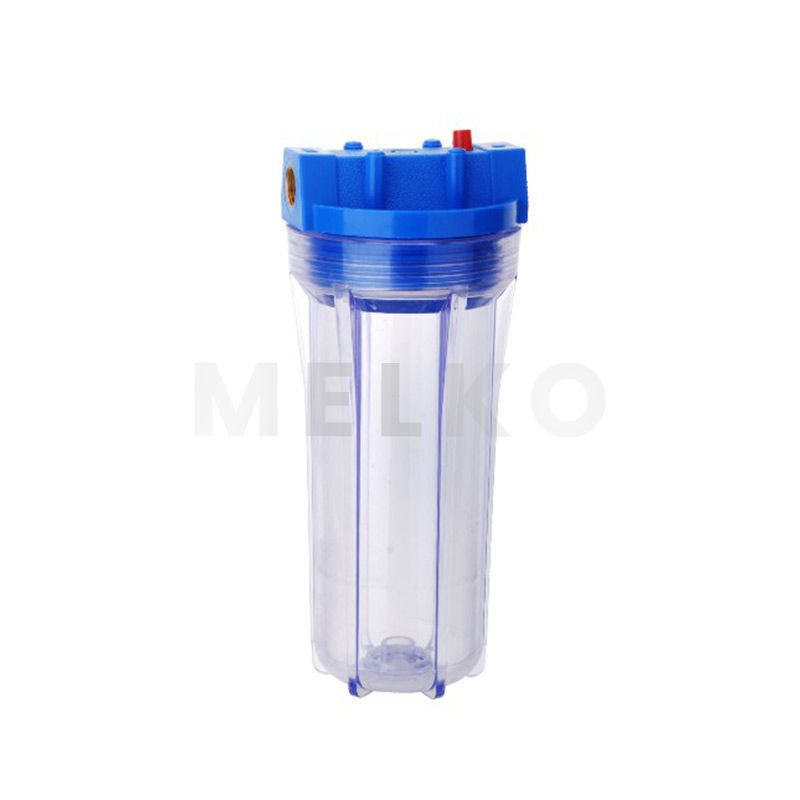
Polyethylene Terephthalate (PET) is rapidly dominating the high-performance liquid containment market. Engineers originally popularized PET for carbonated beverage packaging because it safely holds pressurized liquids. Today, manufacturers mold thick, engineering-grade PET into robust filtration vessels. This adaptation fundamentally changes how we approach residential and commercial water purification designs.
PET’s distinct molecular structure offers superior rigidity compared to standard unreinforced PP. It boasts exceptional tensile strength. This structural density successfully prevents the housing from bulging or deforming under sustained static pressure. Creep resistance ensures the housing maintains its exact physical dimensions over years of continuous use. You do not have to worry about the vessel stretching out of shape.
The operational advantages of PET extend far beyond simple burst strength. Manufacturers can produce PET with glass-like transparency without sacrificing any structural integrity. This optical clarity transforms routine maintenance. Technicians and homeowners can perform a visual inspection of filter fouling instantly. You can check sediment accumulation without dropping system pressure or unscrewing the sump. This visual feedback loop prevents premature filter swaps and ensures timely maintenance.
Modern water systems demand high volume. A PET filter casing purifier safely supports the aggressive operating pressures required for modern high-flow, tankless filtration systems. Tankless RO units push water violently through membranes on demand. The enhanced burst pressure rating of PET handles these intense mechanical demands flawlessly. It allows designers to maximize pump output, guaranteeing rapid flow rates at the final dispensing faucet.
Ignoring material science leads directly to catastrophic mechanical failures. The structural shell experiences immense stress every single day. When inferior materials begin degrading, several predictable failure points emerge in the field.
O-ring seat deformation represents the most common silent failure. Inferior plastics warp slowly under continuous pressure cycles. The precision-milled groove holding the rubber O-ring slowly stretches. It loses its tight mechanical tolerance. Once the groove expands, the O-ring cannot maintain a watertight seal. This process results in slow, virtually undetectable leaks. Water seeps out drop by drop, often rotting cabinet floors before anyone notices the issue.
Thread galling and seizing create massive maintenance headaches. As cheap materials degrade or warp under stress, the threaded connections distort. The sump essentially locks onto the main cap. Future filter replacements become incredibly difficult. Technicians often resort to strap wrenches and brute force. This risks severe thread stripping during routine servicing. Once you strip the threads, the entire assembly requires complete replacement.
UV and environmental degradation further complicate system longevity. Certain plastics become extremely brittle if exposed to direct light. Extreme temperature fluctuations in mechanical rooms or under-sink environments accelerate this breakdown. Standard plastics lose their plasticizers, turning fragile and prone to shattering. Fortunately, specialized material additives and dense PET structures strongly mitigate UV damage. They maintain flexibility and impact resistance despite harsh environmental conditions.
Proper system design requires methodical component matching. You cannot simply guess which housing will survive your specific plumbing environment. Follow this clear progression to guarantee safety and optimal flow rates.
Durable housing polymers are never just an optional aesthetic upgrade. They serve as the strict structural prerequisite for maintaining high flow rates and reliable water purity across all filtration applications.
A: The micron rating becomes entirely useless if the housing structural integrity fails. Warped or deformed housings lose their precise internal tolerances. This distortion allows unfiltered water to slip past the internal O-rings and bypass the filter cartridge entirely. You might install a premium sub-micron membrane, but a weak casing allows sediment, chemicals, and bacteria to flow directly into your clean water supply undetected.
A: Particulate clogging remains the most common primary cause of flow reduction. However, structural limitations play a massive role. If your system runs at a safely reduced pressure to protect a weak outer casing, it lacks the pushing force required to maintain flow. As the filter loads with debris, the already-low pressure cannot push water through the resistance, causing premature and severe flow drops.
A: Yes, it absolutely can be. Engineering-grade PET maintains exceptionally high burst strength and fatigue resistance. It performs comparably to, and often exceeds, traditional opaque plastics like standard polypropylene. The manufacturing process aligns the polymer chains to provide immense tensile strength while remaining fully transparent. Just ensure the specific product meets standard cyclic testing protocols and carries reputable NSF or ANSI structural certifications.
A: A high-quality housing typically lasts between 5 to 10 years under normal conditions. However, actual lifespan depends entirely on your specific plumbing environment. The frequency of pressure cycles, the presence of aggressive water hammer, and the inherent material fatigue limits dictate longevity. We highly recommend replacing plastic housings every decade to prevent catastrophic fatigue failures, regardless of their visual appearance.

