
English 
T: +86-17717097520
E: sales1@melko2015.com
E: sales1@melko2015.com
No.222 Xiangche Rd. Chedun Town Songjiang Dist. Shanghai China 201611


Views: 0 Author: Site Editor Publish Time: 2026-09-11 Origin: Site


Cartridge filtration dictates the reliability of industrial, commercial, and municipal water treatment systems. Plant operators and engineers face continuous demands to maintain fluid purity while minimizing system downtime. The specific filtration media you select directly impacts flow dynamics, maintenance intervals, and the protection of downstream equipment. Facility teams frequently encounter a specific engineering decision: choosing between depth-based media and surface-based media to optimize fluid processing.
This technical breakdown provides an objective, field-focused comparison between a melt blown depth filter and a pleated filter cartridge. By evaluating structural mechanics, particle distribution handling, and operational maintenance requirements, system designers can determine the most efficient solution for their specific fluid streams.
Depth filters utilize a gradient density matrix to capture broad-spectrum, irregular, and gelatinous contaminants throughout the media volume.
Pleated cartridges maximize surface area to deliver high flow rates and precise, uniform particle exclusion at the media boundary.
Gelatinous solids will rapidly blind surface-level pleated media, whereas depth media distributes these deformable particles to maintain flow.
Absolute micron ratings require pleated construction, while nominal pre-filtration tasks align perfectly with depth filter capabilities.
Proper selection relies entirely on analyzing your fluid's particle size distribution and the required terminal differential pressure.
A Melt Blown Filter Cartridge relies on a highly controlled manufacturing process. Extruders push molten polypropylene through specialized dies, creating microfibers that are blown onto a rotating spindle. These fibers thermally bond to one another upon contact. This process eliminates the need for chemical binders or adhesives. The resulting structure is cohesive and self-supporting. It resists chemical degradation and maintains physical integrity even when subjected to fluctuating system pressures.
The structural mechanics of this media feature a gradient density matrix. During the extrusion process, the machine alters the fiber thickness and packing density. The coarse outer layers feature larger void spaces, while the structure transitions to tightly packed, fine inner layers near the core. This progressive density defines how the filter operates in demanding, high-particulate environments.
Progressive filtration traps larger particles near the outer surface. Finer particles bypass the outer layers and penetrate deeper, eventually becoming trapped within the tight inner core. This irregular contaminant handling makes the filter highly effective at capturing multi-shaped, deformable, and gelatinous contaminants. Instead of forming a restrictive cake on the outside, the contaminants distribute throughout the entire volume of the cylindrical wall.
Primary characteristics include a low-to-moderate initial pressure drop. These filters typically carry nominal micron ratings, meaning they capture a stated percentage of particles at a specific size. They feature a strictly disposable design. Plant operators rely on them to provide baseline protection for sensitive downstream equipment like reverse osmosis membranes and fine polishing filters.
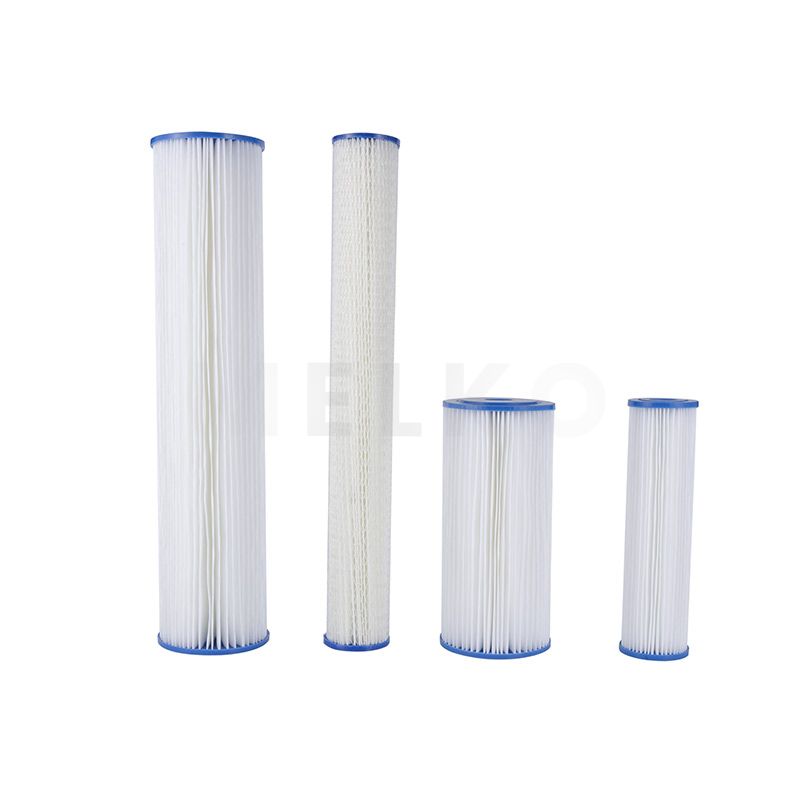
Pleated Filter Cartridges utilize multi-layered media configurations. Manufacturers typically use polypropylene, polyester, micro-glass, or specialized polyethersulfone membranes. The media layers are folded into a fan-like pleated structure around a rigid central support core. The ends are thermally sealed into end caps to prevent any fluid bypass. This construction ensures that 100% of the fluid passes through the filtration membrane.
The structural mechanics focus entirely on maximizing surface area. By folding the media, manufacturers pack a massive amount of filtration surface into a compact, standardized cartridge footprint. A standard 10-inch pleated cartridge can hold exponentially more surface area than a cylindrical depth filter of the exact same dimensions. This increased surface area fundamentally changes fluid dynamics and particle interaction.
Surface filtration intercepts particles directly on the outer membrane layer. This uniform particle capture is optimized for streams where contaminants are of a relatively uniform shape and size. The particles accumulate on the surface, eventually forming a porous filter cake. As long as the particles are rigid and uniform, this cake can actually aid in finer filtration before the pressure drop becomes too severe.
Primary characteristics include exceptionally high flow rates at very low initial pressure drops. These filters often provide absolute micron ratings, guaranteeing the removal of nearly all particles at the specified micron size. Depending on the specific media material and the nature of the contaminants, certain pleated designs offer the potential for cleaning and reusability.
A depth-style progressive filtration matrix handles unpredictable fluid streams. It is best suited for fluids containing irregular, soft, or broad-spectrum particle size distributions. When a fluid contains a mix of sand, silt, and biological matter, the gradient density prevents rapid surface blinding. The varied contaminants find resting places at different depths within the media wall.
Surface-style filtration demands predictability. Pleated designs are best suited for fluid streams with tight, uniform particle size distributions where precise exclusion is required. The massive surface area handles solid, uniform particles efficiently. However, if you introduce deformable solids or heavy biological loading, those soft particles will smear across the pleats and choke off the flow almost immediately.
The surface area versus volume matrix dictates the operational lifespan of the element. Pleated filters offer up to 8 to 10 times the surface area of a depth filter. This yields a significantly longer service life when filtering non-deformable, rigid particles like fine sand or machined metal shavings. The rigid particles stack up on the pleats while leaving microscopic flow channels open.
Premature blinding occurs differently based on the media architecture. Gelatinous particles, oils, and biological slimes quickly coat and blind a pleated filter's surface. They form an impermeable film that drastically reduces lifespan. A depth matrix distributes these deformable particles throughout its entire volume. The tortuous path inside the depth filter absorbs the soft contaminants, maintaining fluid flow and extending the filter's usable life in high-turbidity applications.
Depth filters primarily offer nominal ratings. A manufacturer might rate a depth filter at 90% efficiency for 5-micron particles. This means 10% of those particles will pass through. This nominal precision makes depth media ideal for bulk pre-filtration. You use them to knock down heavy particulate loads and protect more sensitive, downstream components from bulk contamination.
Pleated cartridges are available in highly precise, absolute ratings. They can achieve up to 99.98% efficiency, often expressed as a Beta ratio of 5000. This absolute precision is mandatory for sterile filtration, sub-micron clarity, and point-of-use processing. When a process requires a strict barrier to prevent any particle larger than 0.2 microns from passing, an absolute-rated pleated membrane is the only viable engineering choice.
Pleated designs offer a much lower initial pressure drop at equivalent flow rates due to their high surface area. This clean Delta P advantage allows systems to operate more efficiently right after installation. Pumps work less hard to push fluid through a fresh pleated element compared to a dense depth element.
When calculating flux rates, measured in gallons per minute per 10-inch element, pleated cartridges handle higher flux rates than depth counterparts of the same dimensions. This allows engineers to design smaller filter housings or push higher throughput through existing piping setups. You can process more fluid in less time without spiking the differential pressure.
Melt blown depth filters cannot be backwashed or cleaned under any circumstances. Applying reverse flow will compromise the gradient density structure. It forces the tightly packed inner fibers outward, destroying the matrix and releasing trapped contaminants back into the process stream. They are strictly disposable items. Once the differential pressure reaches the terminal limit, you must replace them.
Certain robust pleated media, such as woven polyester or stainless steel mesh, can withstand gentle backwashing or manual rinsing. This can extend their service life in specific applications. However, standard micro-glass or polyethersulfone membrane pleated filters remain strictly disposable. Attempting to backwash a delicate membrane will rupture the media and cause immediate bypass.
Disposable depth cartridges provide operational simplicity. They require minimal maintenance intervention. Operators monitor the differential pressure gauges. When the pressure hits the change-out threshold, they isolate the housing, pull the spent cartridge, discard it, and drop in a new one. This minimizes system downtime and keeps maintenance labor highly predictable.
Reusable pleated filters require dedicated cleaning overhead. They demand extended downtime and labor for manual washing, chemical soaking, or reverse-flow rinsing. Additionally, facilities must implement strict validation protocols. After cleaning a pleated filter, operators must verify its integrity to ensure no pleats were torn during the washing process.
Depth filters feature a highly accessible entry point for facility procurement. This makes them appealing for applications requiring frequent change-outs due to heavy, unpredictable contamination. If a process fluid is highly turbid and fouls filters daily, using disposable depth media keeps the operation moving without tying up resources in complex cleaning regimens.
Operational longevity depends entirely on matching the filter to the fluid. If you install a depth filter in a clean fluid stream with uniform particles, it will load up faster than a pleated filter. Conversely, if you put a pleated filter in a stream full of biological slime, it will blind in hours. Maximizing lifecycle longevity requires analyzing the contaminant profile before selecting the cartridge architecture.
Municipal and well-water pre-filtration to protect reverse osmosis membranes from silt density fouling.
Chemical processing lines involving varying suspended solids and unpredictable particulate spikes.
Oil and gas production facilities handling produced water filtration and well-injection protection.
Pre-treatment of industrial wastewater containing highly variable particle sizing and trace oils.
Cooling tower side-stream filtration to capture airborne dust and biological debris.
Plating bath circulation where gelatinous byproducts form during the electrochemical process.
Food and beverage clarification, including final polishing for wine, beer, and bottled water.
Pharmaceutical manufacturing requiring sterile air venting and liquid bio-burden reduction.
Electronics and semiconductor fabrication utilizing ultra-high-purity deionized water loops.
Final polishing steps in chemical manufacturing requiring absolute micron control before packaging.
Amine and glycol loop filtration where rigid iron sulfide particles need to be removed efficiently.
Make-up water filtration for high-pressure boiler systems requiring strict particulate limits.
Evaluation Parameter | Melt Blown Depth Filter | Pleated Filter Cartridge |
|---|---|---|
Primary Capture Method | Depth (Gradient Density Matrix) | Surface (High Surface Area Membrane) |
Micron Rating Precision | Nominally rated (bulk reduction) | Absolutely rated (precise exclusion) |
Particle Size Distribution | Wide / Irregular / Deformable | Narrow / Uniform / Rigid |
Initial Pressure Drop | Moderate (requires more pump energy initially) | Low (highly efficient clean Delta P) |
Cleanability/Reusability | No (strictly disposable upon fouling) | Yes (select robust models via backwash) |
Flow Rate Capacity | Standard flux rates per 10-inch length | High flux rates per 10-inch length |
Contaminant Location | Trapped throughout the media wall | Trapped on the outer media surface |
Analyze the fluid characteristics by pulling a sample and evaluating the particle size distribution. Determine if the solids are uniform, highly varied, rigid, or gelatinous.
Assess the deformability of the contaminants. Gelatinous or irregular particles dictate a depth filter, while uniform, hard solids favor a pleated design.
Determine the exact efficiency requirements for the specific point in the process. Assess whether the system needs absolute sub-micron protection or general bulk sediment reduction.
Calculate the required flow rate and the maximum allowable pressure drop for the filter housing. High flow rates with tight pressure constraints usually require pleated elements.
Evaluate the maintenance capabilities of the facility. Decide if the maintenance team has the bandwidth to clean and validate reusable filters or if a simple throwaway depth filter aligns better with operational workflows.
Install pressure gauges on both the inlet and outlet of your filter housings to accurately track differential pressure and establish baseline change-out schedules.
Conduct a particle size analysis on your process fluid to definitively choose between surface and depth filtration media.
Use depth filters as an initial pre-filtration stage to knock down bulk contaminants and protect your more sensitive, absolute-rated pleated filters downstream.
Standardize your filter housing lengths and end-cap configurations to ensure you can easily swap between depth and pleated cartridges if process conditions change.
A: They handle moderate flow effectively. However, pleated filters generally accommodate much higher flux rates at lower pressure drops due to their significantly increased surface area.
A: Gelatinous particles flatten against the surface media of a pleated filter, creating an impermeable layer. Depth filters distribute these soft particles throughout their matrix, preventing rapid surface blinding.
A: No. Absolute ratings are critical for sterile filtration and final polishing. Nominal ratings are usually sufficient for pre-filtration and general bulk sediment removal.
A: Replacement frequency depends entirely on the differential pressure across the filter housing. Manufacturers specify a terminal pressure drop indicating the filter is fully loaded.
A: You can, but it may cause operational issues if the fluid contains broad-spectrum or deformable contaminants that cause premature blinding. Depth filters are typically preferred for pre-filtration.
A: Exceeding the terminal pressure drop can cause the filter cartridge to crush or bypass. This forces accumulated contaminants downstream, potentially damaging sensitive equipment and ruining product batches.


