
English 
T: +86-17717097520
E: sales1@melko2015.com
E: sales1@melko2015.com
No.222 Xiangche Rd. Chedun Town Songjiang Dist. Shanghai China 201611


Views: 142 Author: Site Editor Publish Time: 2026-07-31 Origin: Site


Unplanned downtime and excessive maintenance costs in liquid processing often stem from misconfigured filtration systems. Selecting an inadequate industrial bag filter leads to rapid media blinding, unacceptable pressure drops (Delta P), fluid bypass, and downstream equipment damage. This guide provides an evidence-based framework for evaluating, sizing, and implementing bag filtration systems, moving beyond basic specifications to address operational realities.
Micron rating and flow rate dictate baseline sizing, but fluid viscosity and chemical compatibility determine the long-term viability of the filter.
Material selection—such as choosing PP bag filters over nylon mesh—requires balancing initial procurement costs against dirt-holding capacity and replacement frequency.
Proper housing configuration, secure sealing mechanisms, and routine monitoring of differential pressure are mandatory to prevent bypass and catastrophic filter failure.
Defining the exact role of the filter within the process loop dictates the entire system design. You must know exactly what the filter is supposed to achieve before looking at specifications. Common applications include first-stage bulk solids removal from raw water, pre-filtration to protect sensitive RO membranes, or final polishing of chemical batches before packaging. Each of these scenarios demands a different approach to media selection and housing design.
To establish measurable criteria for filtration success, operators must define specific performance metrics. Without these baselines, you cannot determine if the filtration system is actually working or just acting as a bottleneck.
Target Effluent Quality: Define the maximum allowable particle size and concentration in the downstream fluid.
Acceptable Initial Pressure Drop: Determine the clean pressure drop across the housing and media, which should typically remain below 2 to 5 psid.
Minimum Maintenance Intervals: Calculate the required time between bag change-outs to align with shift schedules or batch runs, preventing mid-process interruptions.
Maximum Operating Velocity: Establish the flow velocity through the media to prevent particle extrusion or media degradation.
The physical working principle relies on an inside-out flow mechanism. Liquid enters the housing and flows from the inside of the bag to the outside. This traps contaminants securely within the media. When the operator removes the bag, the dirt stays inside, allowing for clean, containment-free disposal. The mechanical interaction between the filter housing, the heavy-duty restrainer basket, and the filter media ensures structural integrity. The restrainer basket is non-negotiable; it supports the bag against the differential pressure. Without a properly fitted basket, the bag will rupture almost instantly under flow.
Simplex housings represent single-housing configurations best suited for batch processes. You install these in systems where flow can be safely bypassed or completely shut down during bag replacement. When the pressure gauge indicates a blinded bag, the operator stops the pump, isolates the housing, vents the pressure, and swaps the media. This setup requires minimal floor space and lower initial capital.
Duplex housings utilize parallel dual-housing systems equipped with a central diverter valve assembly. This mechanical arrangement enables continuous operation. When one bag reaches its terminal differential pressure, the operator swings the diverter valve handle. The flow seamlessly routes to the clean standby filter. The operator can then isolate, drain, and service the dirty housing without ever stopping the main process pump. This configuration is standard in continuous manufacturing environments where downtime directly impacts production quotas.
High-flow, high-volume industrial applications push beyond the capacity of single bags. Multi-bag vessels contain anywhere from 2 to 24 bag filters installed in a single large-diameter vessel. This design distributes massive flux rates safely across a much larger surface area, keeping the velocity through each individual bag within acceptable limits. These vessels typically feature heavy-duty davit arms or spring-assisted hinges to help operators lift the massive steel lids during service.
For temporary bypass loops, environmental remediation, or versatile multi-stage plant integration, custom skid-mounted and mobile systems offer engineered, modular configurations. These skids often incorporate pumps, pre-piped manifolds, differential pressure transmitters, and multiple housings in series (e.g., a 50-micron bag followed by a 10-micron bag) to step down particle sizes efficiently.
System Configuration | Best Application | Operational Advantage | Maintenance Requirement |
|---|---|---|---|
Simplex Housing | Batch processing, intermittent flow | Low footprint, simple installation | Requires complete process shutdown for change-outs |
Duplex Housing | Continuous manufacturing, 24/7 loops | Zero downtime during media replacement | Requires regular valve maintenance and dual media stocking |
Multi-Bag Vessel | High flow rates, bulk fluid transfer | Handles massive volumes in a single footprint | Requires lifting equipment for lid; longer change-out times |
Polypropylene offers broad chemical compatibility across a wide pH range and resists most acids and alkalis. This makes PP Bag Filters the default choice for many water treatment and chemical processing applications. However, polypropylene is inherently hydrophobic. Operators must address the operational necessity of pre-conditioning or pre-wetting the bags in aqueous solutions. If you install a dry polypropylene bag into a water system and hit it with full flow, the media will resist the water, causing an immediate and artificial pressure spike. Soaking the bag in a compatible wetting agent or slowly introducing flow overcomes this initial hydrophobicity and establishes steady-state flow.
Construction types vary based on the target efficiency. Standard needle-punched felt provides excellent depth filtration, trapping particles throughout the cross-section of the media. For high-efficiency applications requiring absolute retention, manufacturers use melt-blown microfibers that offer massive dirt-holding capacity. You must note the thermal constraints; polypropylene typically degrades and loses structural integrity above 200°F (93°C).
When process temperatures exceed the limits of polypropylene, polyester felt becomes the standard alternative. Polyester operates effectively up to 300°F (149°C) and offers specific chemical resistances, particularly against certain oxidizing agents and solvents where polypropylene fails. It functions similarly as a depth filtration media but requires careful verification against the specific chemical makeup of the fluid.
Nylon monofilament mesh utilizes a precisely woven structure for surface-level filtration. Unlike felt, which traps dirt inside its matrix, mesh stops particles strictly on its surface. It maintains rigid pore size retention, making it ideal for classifying hard, non-deformable particles. Nylon mesh is also highly durable, making it suitable for scenarios where washability and reusability are viable options, such as capturing large metal shavings or coarse debris.
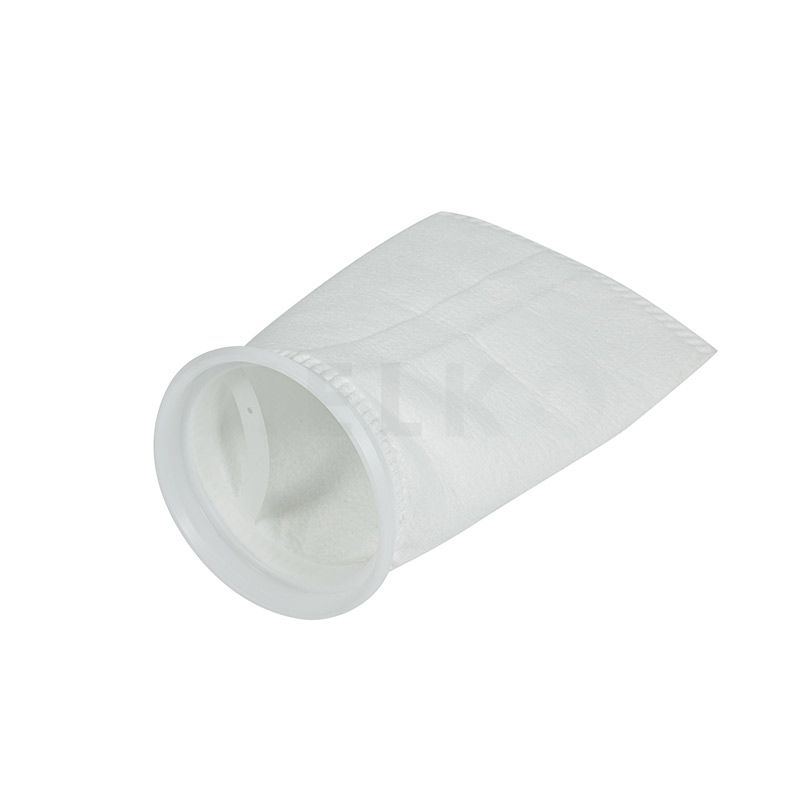
Challenging applications require specialized solutions that go beyond standard felt or mesh.
Oil-Absorbing Bags: These utilize specialized melt-blown polypropylene layers designed to attract and hold trace hydrocarbons while allowing water to pass through, ideal for wastewater discharge compliance.
Graded-Density Bags: These feature multiple layers of media with progressively tighter micron ratings. They handle fluids with wide particle size distributions, preventing premature blinding of the final filtration layer.
Surface Finishes: Singed or glazed treatments on felt media melt the outermost fibers. This prevents fiber migration downstream into clean-fluid zones, which is mandatory in automotive paint or food and beverage applications.
Custom-Engineered Bags: Specific dimensions, heavy-duty stitching, or reinforced structural rings meet proprietary housing specifications or extreme pressure requirements.
Understanding industry testing standards prevents catastrophic misapplication. A nominal rating represents an average efficiency metric. A nominally rated 10-micron bag might only capture 60% to 70% of 10-micron particles. Absolute ratings guarantee a specific particle size cut-off, typically capturing 98% to 99.9% of particles at the stated micron size. You must specify absolute bags when downstream equipment, like an RO membrane or a precision spray nozzle, cannot tolerate any bypass.
Analyzing the Particle Size Distribution (PSD) of the process fluid prevents specifying a micron rating that is unnecessarily tight. If 90% of your contaminant is 50 microns, installing a 5-micron bag will result in rapid media blinding and excessive maintenance frequency. Target the micron rating to remove only the particles that actually cause problems in your specific process.
High-viscosity fluids, such as resins, paints, adhesives, and syrups, drastically reduce allowable flux rates. You cannot size a filter housing for 1000 cps oil using the same flow charts designed for 1 cps water. High viscosity necessitates larger or multiple housing configurations to keep the differential pressure within safe limits.
Calculating the required filter surface area based on the maximum flow rate maintains an optimal velocity through the media. If the velocity is too high, the fluid will force deformable particles (like gels or biological matter) straight through the pores of the bag. Furthermore, housing inlet geometries impact performance. Top-inlet designs route fluid directly over the top of the bag, reducing headspace turbulence and ensuring even flow distribution. Side-inlet designs often require the fluid to flow around a baffle or through the side of the basket, which can impact pressure drops and complicate the cleaning of the housing interior.
Fluid Viscosity (Centipoise - cps) | Typical Fluid Example | Flow Rate Derating Factor |
|---|---|---|
1 cps | Water | 1.0 (No derating) |
50 cps | Light Machining Oil | 0.5 (Reduce flow by 50%) |
500 cps | Heavy Syrup / Resin | 0.1 (Reduce flow by 90%) |
2000+ cps | Thick Adhesives | Requires custom sizing and heating jackets |
You must differentiate between the Maximum Allowable Working Pressure (MAWP) of the stainless steel or carbon steel housing and the differential pressure limits of the bag itself. A housing might be rated for 150 psi, but the filter bag inside will rupture if the differential pressure across it exceeds 25 to 30 psid. The housing contains the fluid; the bag does the work.
Temperature fluctuations during operation alter fluid viscosity and impact the structural integrity of polymer-based bags. A fluid that flows easily at 150°F might thicken significantly if the temperature drops to 100°F, causing a sudden spike in differential pressure. You must select materials based on the maximum possible temperature the system will experience, not just the normal operating baseline.
The trade-off between bag and cartridge filters involves balancing capital expenditures against operating labor and consumable costs. Bag filter housings generally require lower capital expenditure. A single-bag housing is mechanically simpler than a multi-round cartridge housing. However, high-solids applications may incur higher operating costs due to frequent change-outs, as standard bags have less total surface area than pleated cartridges.
Bag filters typically offer faster, simpler replacements in high-volume industrial environments. Opening a housing, pulling out one large #2 bag, and dropping in a new one takes minutes. Replacing twenty individual 30-inch cartridges in a multi-round vessel takes significantly longer and introduces more opportunities for seating errors. You must evaluate scenarios where high-flow, large-diameter cartridges might outperform standard size #2 bag filters based on strict dirt-holding capacity requirements, versus the raw ergonomic speed of bag systems.
Creating a positive seal is the most critical mechanical requirement of the system. If fluid bypasses the bag, the filter is useless. Evaluate the efficacy of different bag top rings. Galvanized steel snap rings rely on the housing lid or an internal hold-down plate to compress them against the basket lip. Molded plastic V-rings or flanges offer a superior seal; they expand under the pressure of the fluid, actively pressing against the housing wall to eliminate bypass paths. Strict installation procedures ensure the bag is fully seated within the restrainer basket. If the bag is twisted or not pushed all the way down, the fluid pressure will stretch and rupture the media.
Venting entrapped air from the filter vessel housing during initial filling prevents hydraulic lock and erratic pressure readings. Every housing has a vent valve on the lid. You must open this valve, slowly introduce fluid until liquid escapes from the vent, and then close it. Failing to vent the air leaves a compressible gas pocket inside the housing. When the pump kicks on, this air compresses and then violently expands, causing hydraulic shock (water hammer). This shockwave will tear the seams of the bag or dislodge the filter media entirely.
Slowly ramping up flow during commissioning avoids this mechanical stress. Never open an isolation valve instantly on a high-pressure system. Crack the valve, let the housing pressurize and equalize, and then bring it to full flow.
Installing pressure gauges upstream and downstream establishes baseline pressure drops. You cannot operate a filtration system blindly. Define critical Delta P thresholds, typically 15-20 psid, that signal the exact moment for a change-out. Exceeding these limits forces the pump to work harder and risks pushing trapped contaminants through the media pores (media migration). If you ignore the gauges and hit 30+ psid, the bag will rupture, dumping all the accumulated dirt directly into your downstream process.
Operators handling heavy, fluid-soaked bags must follow strict safety protocols. A standard #2 bag full of water weighs over 30 pounds; a bag full of high-density sludge weighs significantly more. When processing hazardous, corrosive, or volatile chemicals, operators must wear appropriate PPE and utilize housing drain valves to empty the vessel completely before opening the lid. Routine inspection of housing O-rings, restrainer baskets, and closure mechanisms, such as quick-opening swing bolts or V-band clamps, ensures long-term system integrity and prevents external leaks.
Audit your current fluid viscosity and chemical makeup to lock in the correct housing material and bag media before looking at micron ratings.
Install upstream and downstream pressure gauges on all existing housings to establish a strict 15-20 psid change-out protocol.
Switch to molded plastic V-ring bags if your current system experiences any trace of downstream particle bypass.
Submit a fluid sample for Particle Size Distribution (PSD) analysis to stop guessing and specify the exact absolute or nominal micron rating required.
A: Lifespan varies entirely based on fluid viscosity, particulate load, and flow rate. You do not change bags based on time. Change-outs are dictated strictly by differential pressure (Delta P), requiring replacement when the gauge reaches 15-20 psid.
A: Choose polypropylene for broad chemical compatibility and operating temperatures below 200°F (93°C). Select polyester for applications requiring higher temperature tolerance up to 300°F (149°C) or specific chemical resistances where polypropylene degrades.
A: The maximum acceptable differential pressure is 15-20 psid. Exceeding this threshold significantly increases the risk of bag rupture, forces trapped dirt through the media, and causes severe downstream contamination.
A: Nylon monofilament mesh bags can often be washed and reused because they capture dirt on the surface. Depth filtration media like polypropylene or polyester felt trap particles internally; they cannot be effectively cleaned and require disposal.
A: High-viscosity fluids resist flow, creating higher initial pressure drops. You must derate the flow capacity of the filter, requiring larger housings or multi-bag vessels to maintain acceptable velocities and prevent immediate media blinding.
A: Prevent bypass by upgrading to bags with molded plastic V-rings that expand under pressure to seal against the housing wall. Always verify the bag is fully pushed down and correctly seated inside the metal restrainer basket before closing the lid.


