
English 
T: +86-17717097520
E: sales1@melko2015.com
E: sales1@melko2015.com
No.222 Xiangche Rd. Chedun Town Songjiang Dist. Shanghai China 201611


Views: 126 Author: Site Editor Publish Time: 2026-08-03 Origin: Site


Chemical and process filtration carries high stakes. Improper media selection directly causes batch contamination, unplanned downtime, and hazardous fluid exposure. Many facilities treat filter replacement as a generic purchasing task. They simply order the same size without evaluating current process conditions. This approach fails when fluid viscosity, chemical aggressiveness, or flow rates change. You must treat filtration as a process engineering decision. Variations in your process demand precise specification to maintain product quality and protect downstream equipment. Evaluating and selecting the correct industrial bag filter requires a structured approach. You need to analyze technical specifications and material compatibility. Fluid characteristics dictate the media. Operating pressures determine the structural requirements. A mismatched filter leads to fluid bypass, rendering the entire system useless. We will walk through the exact framework for specifying the right filtration media for your chemical processes.
Micron Rating Accuracy: Differentiate between nominal and absolute ratings; success depends on matching the rating to the specific particle size distribution of the process fluid.
Chemical and Thermal Compatibility: Emphasize that fluid characteristics (pH, temperature, solvents) dictate media selection, with options ranging from Single-Use PE Filter Bags to specialized PTFE.
Differential Pressure (Delta P): Highlight the importance of monitoring pressure drops to optimize change-out schedules and prevent filter rupture.
System Integration: Note that the best bag filter will fail if the sealing mechanism (ring type) does not perfectly match the existing filter housing, leading to fluid bypass.
You must establish clear baseline performance metrics before selecting any media. Define your target fluid cleanliness first. Determine the maximum acceptable pressure drop for your system. Calculate the required throughput per shift. These metrics form the foundation of your filtration strategy. Simply ordering a same-size replacement ignores potential shifts in your process. Fluid viscosity often changes due to temperature variations. Operating temperatures might fluctuate based on seasonal facility conditions. Re-evaluating these parameters ensures your filtration system actually performs as intended. Relying on outdated specifications guarantees subpar results. Engineers must look at the entire fluid pathway. A pump upgrade upstream changes the velocity hitting the media. A change in raw material suppliers alters the particulate load. You have to measure these variables on the floor. Grab a sample of the fluid. Run a particle size analysis. Check the current gauge readings on the housing. Documenting these baseline numbers prevents guesswork when specifying the replacement media.
Process run lengths heavily influence your media choice. Continuous operations run 24/7. They favor high-capacity, multi-layered systems. These designs maximize runtime and reduce maintenance intervals. Batch operations function differently. You must align the filter life with the specific batch size. A filter blinding mid-batch causes severe system shutdowns. This ruins product consistency and wastes valuable chemical ingredients. Evaluate your production schedule. Match the dirt-holding capacity of the media to your specific run times. Do not use a standard batch filter for a continuous high-volume process. In a continuous amine unit, for example, operators cannot afford to shut down the flow every four hours. They need extended-life media. In a specialty resin batch process, the run might only last six hours. The media only needs to survive that specific duration without blinding. Understanding this dynamic dictates whether you specify standard felt or a high-capacity pleated design.
Filtration rarely relies on a single component. You typically use these filters as cost-effective first-stage solutions. They handle high capacities of bulk solids. They act as pre-filtration before expensive membrane or cartridge filters. Removing large particulates early protects downstream equipment. It extends the life of absolute-rated final filters. Understand where this component sits in your overall process train. Do not expect a primary bulk filter to achieve sterilization-grade clarity. Use it to remove the heavy contaminant load efficiently. If you place a 1-micron absolute filter directly after a mixing tank filled with raw slurry, it will blind in minutes. You need a 50-micron or 100-micron pre-filter to catch the bulk debris. This staged approach keeps the entire system running smoothly. It prevents the final polishing filters from overloading. Map out your entire filtration train. Identify exactly what each stage needs to accomplish.
Evaluate the specific solids you need to remove. Rigid particles behave differently than deformable or gelatinous particles. Rigid solids build a porous cake on the media surface. Gelatinous particles smear and blind the pores immediately. Measure the concentration in parts per million (ppm). Analyze the particle size distribution. High solid loading demands larger surface areas. You might need graded-density designs to handle heavy concentrations. These designs trap larger particles on the outside and finer particles inside. This prevents immediate surface blinding and extends operational life. When dealing with rust or pipe scale, the particles are hard. They stack up and still allow fluid to pass through the gaps. When filtering biological matter or unreacted polymers, the particles are soft. They extrude under pressure. They flatten out and seal the media. You have to identify the physical nature of the contaminant. This dictates the required media structure.
Micron ratings confuse many operators. Nominal ratings indicate average particle capture. A 10-micron nominal bag might only capture 60% of 10-micron particles. Absolute ratings guarantee capture at a specific micron size. They often provide 99% efficiency or higher. Decide which rating type you need based on process criticality. If you are protecting a pump, nominal ratings usually suffice. If you are filtering a final chemical product before packaging, you need absolute ratings. Match the rating strictly to your quality control requirements. Do not over-specify the micron rating. Choosing a 1-micron absolute media for a cooling water loop wastes resources. It will blind constantly. Choose a 50-micron nominal media instead. Save the absolute ratings for the final product transfer lines where particulate contamination ruins the batch.
Standardized sizes dominate the industry. They fit most commercial housings. Knowing these dimensions helps you calculate capacity. Standard sizes work for most applications. However, custom geometries become necessary for legacy housings. Some older OEM installations use proprietary dimensions. Never force a standard size into a mismatched housing. This guarantees bypass and structural failure. Measure your internal basket dimensions carefully before ordering.
Trade Size | Dimensions (Diameter x Length) | Typical Surface Area (sq. ft.) | Volume Capacity (Gallons) |
|---|---|---|---|
Size 1 | 7" x 16" | 2.0 | 2.1 |
Size 2 | 7" x 32" | 4.4 | 4.6 |
Size 3 | 4" x 8" | 0.5 | 0.4 |
Size 4 | 4" x 14" | 1.0 | 0.7 |
When measuring a legacy housing, pull the support basket out. Measure the inside diameter of the basket. Measure the overall length from the seating flange to the bottom. Compare these numbers to the standard trade sizes. If your basket is 6 inches in diameter, a standard Size 1 or Size 2 will not fit properly. It will bunch up and fail. You must source a custom-sewn media to match that specific basket profile.
Fluid thickness changes everything. High-viscosity fluids drastically reduce effective flow rates. Resins, adhesives, and heavy chemicals move slowly. A standard size 2 housing might handle 100 GPM of water. It might only handle 10 GPM of a thick polymer. Calculate your required surface area based on the maximum allowable flow rate. Monitor fluid velocity limits to avoid media deformation. High velocity pushes soft particles straight through the pores. Adjust your sizing calculations to account for fluid thickness at the actual operating temperature. Cold fluids are thicker. A lube oil flows easily at 150°F. At 60°F, it barely moves. You must size the system based on the worst-case scenario. If the process starts up cold, the media must handle that initial high-viscosity surge without blowing out.
Fluid Viscosity (Centipoise - cps) | Example Fluid | Flow Rate Multiplier (vs. Water) |
|---|---|---|
1 cps | Water | 1.00 |
50 cps | Light Machining Oil | 0.50 |
500 cps | Heavy Gear Lube | 0.10 |
2000+ cps | Thick Resins / Adhesives | 0.02 |
Dirt loading increases differential pressure. As pores plug, pressure upstream rises. You must monitor this Delta P constantly. Standard industry thresholds for change-outs sit between 15 and 20 psid. Exceeding this limit degrades the media. It forces contaminants through the fabric. Extreme pressure causes catastrophic rupture. A blown filter dumps all collected dirt downstream. Install pressure gauges on the inlet and outlet of your housing. Establish strict maintenance protocols based on these gauge readings. Do not rely on a calendar schedule. Changing the media every Tuesday is a flawed strategy. The dirt load dictates the change-out. If a bad batch of raw material enters the system, the media might blind in two hours. The gauges tell you exactly when the media is spent. Train your operators to read the Delta P and act immediately when it hits 15 psid.
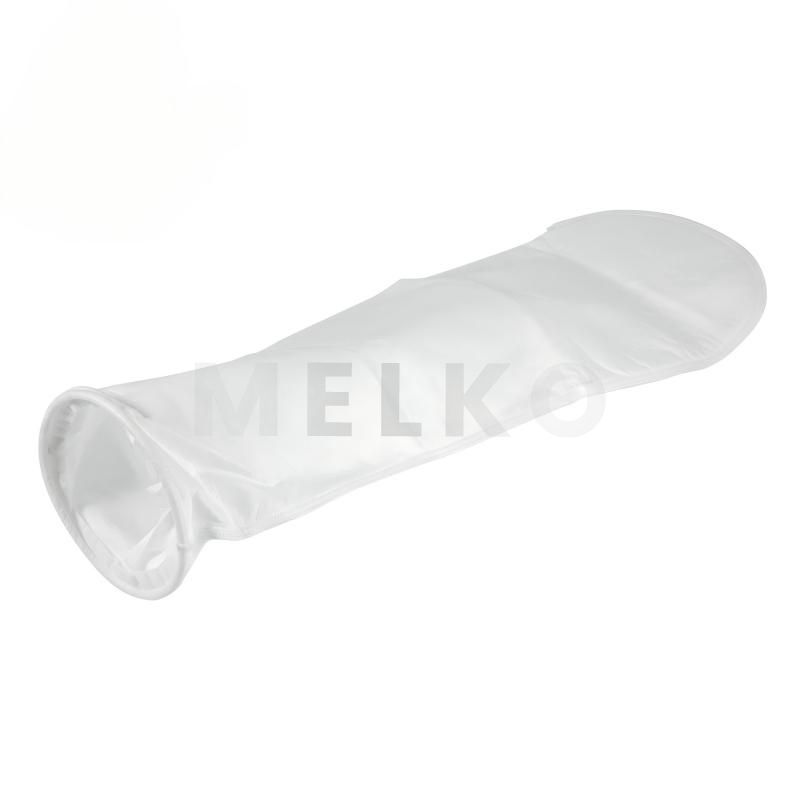
Polypropylene offers broad chemical resistance. It handles acids and alkalis well. PP works perfectly in standard temperature applications up to 200°F. However, it fails in higher heat. Single-Use PE Filter Bags utilize polyester construction. Polyester handles slightly higher temperature environments up to 300°F. It provides excellent compatibility with specific oxidizing agents and various solvents. Choose PE when your process exceeds the thermal limits of standard polypropylene. Verify the specific chemical concentration before finalizing the material choice. A 10% sulfuric acid solution behaves differently than a 98% concentration. Polypropylene might survive the weak acid but melt in the strong acid. Always consult a chemical compatibility chart. Cross-reference the exact chemical, the concentration percentage, and the operating temperature. If any of those three variables change, you must re-verify the material compatibility.
Nylon monofilament mesh provides precise classification. It excels at surface filtration for hard particulates. However, nylon degrades in strong acids. PTFE represents the premium choice for aggressive environments. It withstands highly aggressive chemicals and strong acids. PTFE survives extreme thermal conditions where standard polymers melt or dissolve. Use PTFE only when absolutely necessary due to its higher upfront requirement. Match the polymer strictly to your chemical safety data sheets. When dealing with aggressive solvents like MEK or toluene, standard plastics swell and lose their structural integrity. PTFE remains inert. It will not swell, degrade, or leach into the process fluid. This makes it mandatory for high-purity solvent filtration. Evaluate the chemical makeup of your fluid stream. If it contains mixed solvents or aggressive halogens, default to PTFE to ensure system safety.
Construction type determines how the media traps dirt. Needle-punched felt provides depth filtration. It offers high dirt-holding capacity by trapping particles throughout its cross-section. Felt works best for bulk solids and gelatinous materials. Woven mesh provides surface filtration. It features precise, uniform pore sizes. Mesh works well for hard particles and classification tasks. You can often wash and reuse mesh in specific non-critical applications. Choose felt for capacity and mesh for precision. If you are filtering a slurry with a wide range of particle sizes, felt captures the dirt efficiently. The tortuous path inside the felt traps the debris. If you are filtering a clear liquid to remove a few stray hard particles, mesh works perfectly. The particles hit the surface and stop. You can pull the mesh out, hose it off, and put it back in service.
Felt media inherently sheds loose fibers. You cannot allow these fibers into a finished chemical product. Manufacturers apply surface treatments to prevent this migration. Glazed finishes melt the outer fibers slightly. Singed finishes burn off loose strands. Always specify a glazed or singed finish for chemical processing. Untreated felt contaminates downstream batches. Verify the surface treatment visually before installation. The exterior should look smooth and uniform. If you rub your hand across the outside of the media and fibers come off, it is untreated. Do not install it in a critical process line. Those fibers will end up in your final product, causing quality control failures. Specify the exact surface treatment on your purchase orders to prevent receiving the wrong construction.
Environmental variables degrade media outside of process chemistry. Outdoor UV exposure breaks down polypropylene quickly. Continuous contact with atmospheric oxygen degrades certain polymers over time. High-temperature steam sterilization causes hydrolysis in polyester. Hydrolysis destroys the structural integrity of the fabric. Evaluate the physical environment around your filter housing. Store replacement media in dark, climate-controlled areas. Protect installed housings from direct sunlight if mounted outdoors. If you leave a box of polypropylene media sitting on a loading dock in the sun for a month, the plastic becomes brittle. When you install it and apply pressure, it shatters. Keep your inventory inside. If your process involves steam-in-place (SIP) sterilization, do not use polyester. The steam will break the polymer chains. Switch to a material that withstands high-temperature moisture.
The top ring supports the entire structure. Galvanized steel rings offer basic rigidity but rust easily. Stainless steel rings resist corrosion in harsh chemical environments. Molded plastic rings integrate directly with the media. The chemical compatibility of the ring must match both the fabric and the target fluid. A stainless ring in a hydrochloric acid process will corrode rapidly. Use polypropylene or polyester rings for aggressive acids. Ensure the ring material matches the housing seat perfectly. If you use a plastic ring in a housing designed for a metal ring, it might not seat correctly. The dimensions differ slightly. The plastic ring might be thicker. This prevents the housing lid from closing properly. Always verify the ring style against the housing manufacturer's specifications.
Bypass destroys filtration efficiency. Unfiltered fluid escapes around the collar when the seal fails. V-rings rely on internal pressure to expand and seal. Snap rings snap into a machined groove. Positive-seal molded plastic flanges provide the best security. Sentinel-style seals crush slightly under the housing lid to form a perfect barrier. Inspect the housing seat for wear or chemical pitting. A damaged seat allows bypass regardless of the ring type used. Run your finger around the seating surface inside the housing. If you feel grooves, pits, or scratches, fluid will leak past the seal. You must repair or replace the housing. Even the best media cannot overcome a damaged seating surface. Ensure operators clean the seat thoroughly during every change-out. A single piece of grit left on the seat creates a leak path.
Every Bag Filter relies on an internal perforated support basket. The fabric cannot withstand operational pressures alone. The basket provides the necessary structural backing. You risk catastrophic rupture if the basket is damaged. Improperly cleaned baskets restrict flow and cause localized pressure spikes. Misaligned baskets pinch the fabric and create weak points. Always inspect the support basket during every change-out. Replace dented or corroded baskets immediately. If a basket gets dropped on the concrete floor and dents, do not put it back in the housing. That dent creates a void. When pressure applies, the fabric stretches into that void and tears. The basket must be perfectly cylindrical. Clean the perforations regularly. If the holes plug with dried chemical residue, the effective surface area drops drastically.
Deformable particles pose a severe risk. Gelatinous contaminants extrude into the pores and block flow instantly. This causes premature blinding and rapid pressure spikes. Standard single-layer media fails quickly in these conditions. To mitigate this, use multi-layered or graded-density designs. These structures distribute the contaminant load throughout the depth of the fabric. They prevent surface smearing. You can also reduce the flow rate to lower the velocity pushing the gels into the pores. Slowing the fluid down prevents the soft particles from wedging deeply into the media. If you pump a gelatinous fluid at 100 GPM, it blinds in ten minutes. If you slow the pump to 30 GPM, the media might last for days. Velocity control is critical when handling soft contaminants.
Identify the nature of the contaminant (hard vs. soft).
Select a graded-density media for soft, gelatinous particles.
Install a variable frequency drive (VFD) on the feed pump to control flow velocity.
Monitor the Delta P closely during the initial run to establish a baseline.
Sourcing media from new vendors for legacy housings carries dimensional risks. Slight variations in ring diameter prevent a proper seal. A fabric that is too long bunches up at the bottom of the basket. This restricts flow and causes premature wear. To mitigate this, perform physical sample testing first. Match the flange profiles exactly. Take precise internal housing measurements before placing bulk orders. Never assume a generic trade size fits a proprietary older housing perfectly. Request a sample from the new vendor. Install it in the housing. Close the lid. Run water through the system. Check for bypass. Pull the media out and inspect it for pinch marks or bunching. Only after a successful physical test should you issue a purchase order for the facility.
Measure your internal housing and support basket dimensions to confirm exact trade size requirements before ordering.
Check your chemical safety data sheets against the compatibility charts for PP, PE, and PTFE materials.
Install pressure gauges on your housing inlet and outlet to monitor differential pressure accurately.
Order a small sample batch to test for fluid bypass and actual dirt-holding capacity before bulk purchasing.
A: Nominal ratings indicate an average particle capture efficiency, often around 60-70% for the stated size. Absolute ratings guarantee capture of particles at the specified micron size, typically at 99% efficiency or higher. Use absolute ratings for critical chemical processes.
A: Rapid blinding usually occurs due to gelatinous contaminants smearing the surface or flow rates that are too high for the fluid's viscosity. Switching to a graded-density depth media and lowering the fluid velocity often solves this issue.
A: Polypropylene generally degrades above 200°F. For higher temperatures, you should switch to polyester, which handles up to 300°F, or use PTFE for extreme thermal and aggressive chemical conditions.
A: Monitor the differential pressure (Delta P) across the housing. Industry standards dictate changing the media when the pressure drop reaches 15 to 20 psid. Waiting longer risks media degradation or rupture.
A: Bypass happens when the top ring does not seat correctly in the housing. This results from using the wrong ring style, a damaged housing seat, or dimensional mismatches between the media collar and the internal basket.


